from Cape Verde Blog

POS532: Tracing elusive deep-sea squid using environmental DNA

A fragile jellyfish drifting in deep water. Eine in der tiefen Wassersäule driftende Qualle. Foto JAGO-Team / GEOMAR

[deutsche Version unten] by Stella Scheer and Veronique Merten The PhD students Stella Scheer and Veronique Merten of the Deep-Sea Biology Working Group at GEOMAR are reporting here about a method to trace marine animals without observing the animals During our cruise we sampled five different locations for environmental DNA (eDNA), including in- and offshore […]

from Cape Verde Blog

POS532: First observations on deep water benthic communities in Cabo Verde coastal areas

Rui Freitas inside the JAGO. Rui Freitas im JAGO. Photo: JAGO-Team GEOMAR

(Deutsche Version unten) by Rui Freitas, 22-Feb-2019 Rui Freitas is a marine biologist and lecturer at the University of the Cape Verde. Here he reports about his two dives with the manned submersible JAGO down to the steep slopes of Santo Antão and Fogo. The deeper slopes of the Cape Verde islands have never been […]

from Cape Verde Blog

POS532: JAGO-Pilot werden…/ To become a JAGO pilot

Die beiden JAGO-Piloten Jürgen (hier als “Hakenmann”) und Peter. The two submersible JAGO-pilots Jürgen (in wetsuit as „hookman“) and Peter. Photo: JAGO-Team/GEOMAR

english version below …braucht Zeit und die richtigen Bedingungen! Hier erzählt JAGO-Pilot Peter Striewski von seinem Weg ins „JAGO-Cockpit“ Wer den eng getakteten Forschungsbetrieb auf Ausfahrten mit einem Forschungsschiff kennt, weiß, dass es gar nicht so einfach ist, Zeit zum Üben eines reibungslosen Einsatzes von mitgebrachten Geräten und – wie in unserem Fall – Fahrzeugen […]

from Cape Verde Blog

POS532: Cape Verde Cruise / Tiefseeforschung vor den Kapverden

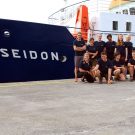
JAGO-Die Fahrtteilnehmer der POSEIDON-Reise POS532. The Participants of POSEIDON cruise POS532. Photo: JAGO-Team/GEOMAR

(Deutscher Text unten) Participants of the research cruise POS532 give insight into their work on board the FS POSEIDON. The cruise takes place between the 04 and 24 of February 2019. The introduction to the cruise is given by Henk-Jan Hoving, Deep Sea Biologist and Head of an Emmy Noether Research Group at GEOMAR. During […]

Mikroplastik im Strandanwurf

Von Sinja Dittmann Wer kennt sie nicht, die „Grashaufen“, welche im Spülsaum des Strandes angeschwemmt werden. Die Rede ist von Strandanwurf, auch Treibsel genannt, welches an der deutschen Ostseeküste meist aus Seegras (Zostera marina L.) und Algen (Fucus vesiculosus L. und Fucus serratus L.), sowie aus Muschelschalen und Treibholz besteht. Was vielen Seevögeln und Insekten […]

from Ocean Navigator Blog

Global Challenges -A school project on plastic pollution in the ocean

Already in weekend mode? Need something inspirational to read whilst you pour yourself another cup of hot coffee in this cold February weather? We start this month with the next promised (and slightly delayed) blog entry from the 11th grade English class. This entry focusses on some plastic facts and how plastic affects us and […]

from SO267 ARCHIMEDES Blog

The Archimedes-I cruise: back to port

+++ Für die deutsche Version bitte nach unten scrollen +++ All good things come to an end and so is the Archimedes-I cruise. For 48 days, 39 scientists and 31 crew members were onboard of the RV Sonne, cruising the Lau Basin in the south-west Pacific. The cruise was one of a kind because in […]

from Ocean Navigator Blog

Frieren für die Forschung – Das Unterwasserobservatorium bei Boknis Eck erhält ein neue Komponente

Erst als die vier Räder unter Wasser sicher montiert sind, ist der Einsatz für die Forschungstaucher beendet. Foto: Jan Steffen

Nein, das ist nicht meine Uhrzeit. Morgens um sechs Uhr dreißig steheich an der Reventlou-Brücke in Kiel und warte auf die erste Fähre zumSeefischmarkt in der Schwentinemündung. Ein schneidend kalter Wind fegtüber die Förde. Der Winter hat Kiel schließlich doch nocherreicht. Um acht Uhr soll von der Pier des Seefischmarkts dasForschungsschiff ALKOR ablegen. Das  Ziel […]