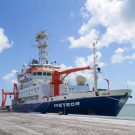
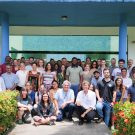
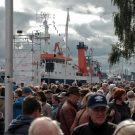
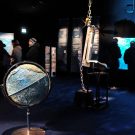
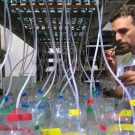
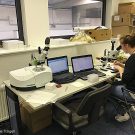
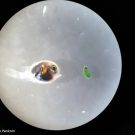
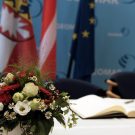
After the fair amount of work on the board and sampling the exciting marine organisms, Alkor brought us safely to Kalmar in Sweden, where two of our scientific crew left and two new participants joined us. For me, as a first-time-on-board-attendee, the arrival at the harbor was a great experience. All our scientific crew went […]
Fish talk!
One important goal of our long-term data series and of the present cruise is to increase the understanding of the feeding ecology, reproduction and population structure of key Baltic fish species. Why is Baltic cod getting thinner? How are herring and sprat competing for zooplankton? How are the two genotypes of cod in the Baltic, […]
First weekly report online!
Time flies out at sea. Benefiting from perfect, calm and sunny weather, we have now already completed hydrographic measurements and fish and plankton sampling in Kiel Bight, Mecklenburg Bight, Arkona Basin, Gdansk Deep and Gotland Basin. For a first summary of work completed till now, check out our first weekly report, now online (in German), […]
SO268: What’s up on the seabed?
At the bottom of the Ocean, in ~4000m water depth they can be found in high abundances: Manganese nodules. Industry and states are interested in these potato-sized objects as a new metal resource. But before commercial mining will start, the potential ecological impacts need to be investigated. Therefore, the project MiningImpact (funded through JPI Oceans) […]
Let’s talk about jellies!
Ina and Silvia from Syddansk Universitet in Odense, Denmark joined the cruise for the EU 2020 Horizon project GoJelly. One key goal of GoJelly is to improve the understanding of the role of jellyfish in marine ecosystems. Today it’s Ina and Silvia’s turn to tell us a bit about their research routine and experiences on […]
AL521 now posting from the Baltic Sea!
It’s spring time, and like every year for us this means that it is time to head out to sea with research vessel ALKOR to extend the Baltic Sea integrative long-term data series, running now in its 33rd year. The mission: to enhance the understanding of the complex and profound changes that Baltic Sea ecosystems […]
Sharing the caring: head of the NanoSIMS lab Dr. Angela Vogts
What is the nature of your work? I am the head of the NanoSIMS lab at the Leibniz Institute for Baltic Sea Research. The NanoSIMS facility is open to all scientists and thus I am in contact with different working groups of the institute as well with national and international scientists. I supervise a technician […]
Das GAME-Programm des GEOMAR startet neue Globalstudie zum Thema Mikroplastik
Das internationale Forschungs- und Ausbildungsprogramm GAME (Globaler Ansatz durch Modulare Experimente) lädt seit 17 Jahren Studierende der Biologie und verwandter Fachbereiche ein, sich an globalen Studien zu beteiligen, die die Auswirkungen menschengemachter Veränderungen auf das Meer untersuchen. Jedes Jahr widmet sich das Programm einer bestimmten Fragestellung und entsendet Teams aus Studierenden an Partnerinstitute auf der […]
Being a female scientist: Aquatic Biogeochemist Emma Kritzberg
Meet Emma Kritzberg, an associate professor of Aquatic Ecology with an emphasis on biogeochemical cycling in freshwater, estuarine and marine systems. Her job includes teaching 15%, doing service (director of undergraduate studies and committee work) 25%, and doing research 60%. What did inspire you to pursue a career in marine sciences/technologies? I did my undergraduate […]
POS532: Im Auge des Zyklonen/ Inside the eye of the cyclon
english version below Die biologische Ozeanographin Helena Hauss und die Ozeanographie-Studentin Anna-Christina Hans erzählen hier von ihrer spannenden Forschung an Strömungswirbeln im Östlichen Atlantik Eines der Ziele unserer Forschungsreise ist, die Rolle von Wirbeln (oder „Eddies“) für das pelagische Ökosystem der Kapverden besser zu verstehen. Wirbel sind rotierende Wasserkörper im Ozean von meist etwa fünfzig […]