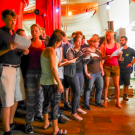
Good Morning and ma nishma everyone! We are Team Israel and would like to introduce ourselves to you on this issue of the monthly blog about our experiences in the GAME project. We are Anna and Lukas and unlike the other teams, ours consist of two German students. But even though both of us are […]
International career at SYKE
Dr. Kirsten S. Jørgensen is a Leading Research Scientist at the Marine Research Center, Finnish Environment Institute SYKE, Finland. She has a 30-year long international career at SYKE Inspired during my biology studies My carrier started at the University of Århus in Denmark. As I was born in Denmark I went to study biology there. […]
The microbial world in the deep sea / Die mikrobielle Welt in der Tiefsee
The smallest life at the seafloor (Deutsch s.u.) by Batuhan Yapan, MPI and Dr. Julia Otte AWI/MPI The deep sea seems very far away from the perspective of our daily life on land. For comparison, the deep seafloor in the northern Pacific is as far away as the clouds in the sky – about 4000 […]
Hard Rock and Heavy Metal: join the microbial deep-sea party! / Hard Rock und Heavy Metal: eine mikrobielle Tiefseeparty!
by Dr. Julia Otte, AWI and Jessica Volz, AWI (deutsch s. u.) What gravity cores can tell us about the biogeochemistry of the Deep The deep sea has fascinated mankind since the early odysseys across the oceans – many myths have been told about the depths of the sea with the dreaded Kraken and Moby […]
Supervising sensitive deep-sea sensors / Überwachung sensibler Tiefsee-Sensoren
by Elena Schiller, AWI (deutsch s. u.) Essentials of deep-sea research technology: The first thing I learnt upon entering a deep sea technology workshop was “non-corrosive steel is non-corroded on the day of delivery”, which leads me to my first topic: materials. We tend to avoid most metals because seawater is highly corrosive. So we […]
Catch It If You Can! – Amphipods in the Deep-Sea
by Tasnim Patel, RBINS Life in the deep-sea is no picnic and dedicating your life to studying our last truly unexplored wilderness isn’t easy either. To sample fauna in the abyssal plains requires courage, expertise, commitment, financial backing and in my case …a pinch of luck. I’m studying deep-sea scavenging crustaceans, which are not only […]
Real or fake? Exploring animal communities associated with natural and artificial polymetallic nodules
by Sabine Gollner and Coral Diaz Recio Lorenzo (Royal Netherlands Institute for Sea Research NIOZ) The growth of the global economy and technological development is increasingly leading to scarcity of certain metals essential for the high-tech industry. Many countries including a number from the EU are currently exploring the potential of deep-sea mineral resource exploitation […]
Deep-sea gardening
by Dr. Freija Hauquier, Ghent University Underneath the seafloor lies an entire world of small animals crawling between the sediment grains, well hidden from the human eye at first glimpse. Yet they are numerous, diverse, and equally deserve our attention in the context of deep-sea mining. Sure, studying them requires a bit more patience than […]
The taste of sediment
by Henko de Stigter (Royal Netherlands Institute for Sea Research, NIOZ) Until somebody came up with the idea of mining polymetallic nodules from the abyssal depths of the Pacific Ocean, this place was one of the remotest and quietest on our planet. Far away from the brute natural forces of storms, floods, landslides, tsunamis and […]
Der letzte Tag an Bord
Unglaublich, aber heute ist schon der letzte Tag meiner Seereise. Die vergangenen Tage sind wie im Flug vergangen. Etwas wehmütig stehe ich an der Reling und schaue über das scheinbar unendlich reichende Wasser. Morgen früh fliegen zwei weitere Wissensschaftler und ich von Aberdeen aus nach Hause, unsere Arbeit ist dann getan. Die Poseidon wird aber […]