I first heard about the CUSCO project when Dr. Mar Fernández-Méndez approached my advisor, Dr. Jeffrey Krause, about sending a member of his lab to participate. The project itself is investigating how changes in a certain physical process, upwelling, will affect the world’s most productive marine fishery off the coast of Peru. Upwelling, for those […]
Planktongeschwabbel
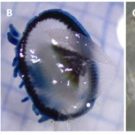
Net hauls have so far provided valuable insights into the gelatinous zooplankton communities along our transect from the Mediterranean Sea into the North Atlantic Ocean. While our sampling sites in the Strait of Gibraltar were mostly populated by pelagic tunicates (salps), several hydromedusae (A. Liriope sp. with abundances of up to 1 ind. m-3), the […]
NETS ON THE ATLANTIC COAST
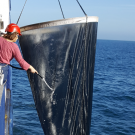
The weather is beautiful off the Portugal coast right now, and we’re having lots of sampling success. We just finished deploying various nets to sample microplastic particles, zooplankton, and gelatinous zooplankton. The net sampling starts with this 1.5m diameter WP3 net. The net is dropped to 100 m, and towed vertically to collect gelatinous zooplankton […]
Watchman, watchman, do you copy?
It is 8 am in Peru, the sun is shining up in the sky and the boats are out on the water sampling. I relieve Toralf, who has been awake since 5am, from his position as watchman for the next 4 hours. Little by little the members of the KOSMOS-CUSCO team are trickling in and […]
Sunny skies
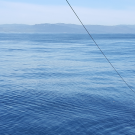
We completed our first two stations without a problem. The Alkor crew knows our gear well, and deployment and retrieval are as smooth as the glassy sea surface right now. We’re collecting water and particles from the CTD/Niskin rosette, underway seawater system, and pumps that filter in situ. We use Bongo nets to collect particles […]
The deep water hunt
32 µmol nitrate per liter – fantastic!! Better than I dared to dream. But let’s start from the beginning. The main objective of our study is to unravel how changes in upwelling intensity affect the food web and elemental cycling in the Peruvian upwelling system. Simply speaking, should upwelling intensity decline let’s say by 50% […]
Finally at sea
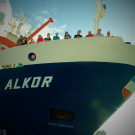
After a day of delay due to bad weather, we’re finally able to leave port. The labs are all set up, and the equipment ready to deploy. Just a few hours to the first station…
from Teaching Ocean Science Blog
AOD Comic: Wellengleichungen im Wassertank
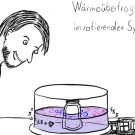
Die wohl beste Zusammenfassung unserer Bemühungen im letzten Semester, Studierenden einen anderen, praxisbezogeneren, letztlich schlicht spaßigeren Zugang zu Atmosphären- und Ozeandynamik (AOD) zu bieten, stammt von Johanna Knauf:
AL534-2
The first official HOTMIC research cruise will be on F/S Alkor, and leaves from Malaga, Spain, on 05 March. The cruise track will follow the European coast from the Mediterranean Sea through the eastern Atlantic, Bay of Biscay, English Channel, and North Sea, to finish in the Baltic Sea at Kiel, Germany, on 01 April. […]
POS536
Technically, the first unofficial HOTMIC research cruise was conducted at the end of summer 2019, in the North Atlantic Gyre on F/S Poseidon. You can read more on their blog here and here.