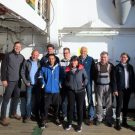
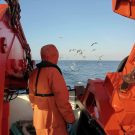
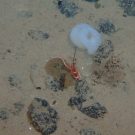
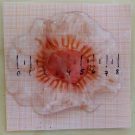
Dies ist bereits der 11. Tag unserer Forschungsreise in die Nordsee. Hier wollen wir die Chemie der Wassersäule sowie die Biogeochemie und Ökologie des Meeresbodens an einem Ort untersuchen, an dem wir im nächsten Jahr experimentell Kohlendioxid unter dem Meeresboden freisetzen werden. Kohlendioxid experminentell freisetzen — das klingt nach einem merkwürdigen wissenschaftlichen Ziel. Aber es […]
Beprobung des Meeresbodens
Um eine Basisstudie über die Makrofauna rund um unser Arbeitsgebiet “Goldeneye” in der Nordsee zu erstellen, nehmen wir Proben der Makrofauna und nutzen die sogenannte Partikelgrößenanalyse (paricle size analysis, PSA). So wollen wir die Struktur der hiesigen Lebensgemeinschaft dokumentieren. Nach dem CO2-Freisetzungsversuch im kommenden Jahr werden wir die Probennahme erneut durchführen, um zu verstehen, wie […]
Ein Schwarm von Sensoren!
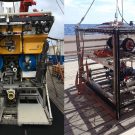
Eines der Ziele dieser Expedition ist es, neue Sensortechnologien des National Oceanography Centre (NOC) in Southampton zu testen. Wir haben 13 autonome chemische Sensoren mitgebracht – die größte Zahl dieser Geräte, die wir bisher gleichzeitig eingesetzt haben! – und setzen sie auf verschiedenen Plattformen ein. Die Sensoren führen chemische Analysen, die normalerweise in einem Chemielabor […]
From ‘coccos’ to climate change: The tools we use to uncover the history of our planet (English]
In a previous blog “Looking into the past to learn about the future” (Read this one first if you haven’t!), you learned why it is important for scientists to study climates of the past, and the significance of our coring locations in the North Pacific Ocean. In other blog entries, you read about the instruments […]
Expedition POS527 ist unterwegs
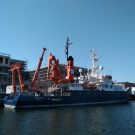
Die Expedition POS527 mit dem Forschungsschiff POSEIDON zur Goldeneye Region in der Nordsee ist ein wichtiger Bestandteil des STEMM-CCS Projektes. Ausrüstung und Abreise Startpunkt für die Expedition war am 14. August 2018 in Kiel. Die Teilnehmerinnen und Teilnehmer reisten vom Plymouth Marine Laboratory (UK), vom National Oceanography Centre Southampton (UK), vom MPI Marine Microbiology (Bremen), […]
Finding the missing piece (English/Deutsch)
The Sonne cruise 264 focuses on geological topics, but there is still room for other scientific endeavours like Hydrography. Hydrography in this case is used to explore the seafloor’s surface below the deep sea. The ocean floor has a certain landscape or topography like dry land, which is, however, hidden under vast masses of water. […]
The plankton are calling… (English/Deutsch)
…from the depth of the ocean. Thousands of microscopic organisms are swimming around, either to catch some food or just hanging out in the currents and enjoying the silence. Planktonic organisms are an important part of the ocean’s ecosystem and during our expedition we want to learn as much as possible about them. Since we […]
Why we are here – Videolog Folge/Episode 2 (Deutsch/English Subtitles)
Chief scientist Dirk Nürberg speaks about the goals of the research expedition to the Emperor seamount chain and introduces the different scientist and their different disciplines. (filmed and edited by Steffen Niemann)
Biscuits from the ocean (English/Deutsch)
Halftime! We have been on the deep-sea research ship Sonne for a month now and even though the initial excitement of the expedition has slowly eased, it has not yet become boring for me in any way. I am the youngest participant on board and this is not only my first scientific voyage, but also […]
Die OSPAR-Methodik
Wieviel Müll liegt eigentlich an unseren Ostseestränden? Und wie setzt sich dieser Müll zusammen? Um diese Fragen zu klären, haben die Wissenschaftler des GEOMARS und der Forschungswerkstatt an zehn Stränden Müll aufgesammelt und klassifiziert. Damit die untersuchten Strände hinsichtlich Zusammensetzung und Menge des Mülls auch vergleichbar sind, wurde die Methodik der OSPAR-Kommission angewandt. OSPAR ist […]