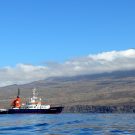
(Deutsche Version unten) Between the 14 Feb and 1 March 2018 expedition POS520 with RV POSEIDON and the submersible JAGO takes place off the coast of the cape verde island Santo Antão. The chief scientist, the JAGO team and participants of the cruise write here as guest writers. Today Henk-Jan Hoving, GEOMAR, Deep Sea Biologist, […]
GAME 2018: Grazing in a warmer ocean revisited – will marine invertebrates change their food preferences?
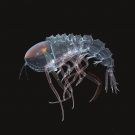
In the last GAME project, the student teams found experimental evidence for the assumption that consumption rates of herbivorous invertebrates will increase when the ocean gets warmer. However, their experiment was (like all experiments) somehow limited, since they offered their test animals a mono-diet that did not give them the chance to change their food […]
To fish in muddy waters…
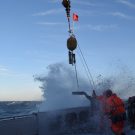
Doing science at sea has its very own rules – just like the German soccer cup or DFB-Pokal, for which the saying goes: The cup makes its own rules. The teams dedicate many months to a thorough preparation, all options are evaluated, everything is double-checked, every tactical variation is considered and at the end everything […]
Ocean bottom What??
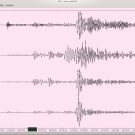
If you want to get an image of the Alps, you need seismometers surrounding the area. But how do you get the seismometers to work at the bottom of the sea? And how do you get them back? To explain this, we invite you to a virtual journey on board of the research vessel Maria […]
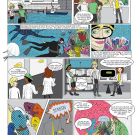
Science Comic – English version
Finally, here is the english version of the science comic developed in cooperation with the scientist Dr. Lucia Pita and the science illustrator Dr. Susanne Landis, Scienstration. If the font is too small to read on the screen: simply zoom in on the image with the key combination “ctrl” and “+”. Keep your eyes peeled […]
EN ROUTE !
With a few hours delay we left the port of Las Palmas on Gran Canaria to sail to the Ligurian Sea. The start of MSM 71 indeed proved stormy: The Atlantic waters greeted us with winds of 7 Bft and gales of up to 10 Bft with waves of 6 m height. Nonetheless, everybody on […]
We reached Mindelo / Wir haben Mindelo erreicht
An expedition can never be fully planned in advance. At sea, everything can evolve differently every day, every hour. So was the case for this trip. The drifter, which was supposed to be followed until the 7th of February, left the upwelling patch and was heading at high speed to the south. As a result, […]
Sifting water in front of the Mauretanian Coast / Wasser sieben vor der Küste Mauretaniens
The week is starting onboard POSEIDON. Slowly the sun rises, immersing the sea for a brief moment in orange-red light. Eight o’clock. The work on the deck and in the laboratories is going on. The day begins with the measurement of the microstructure sonde, followed by the CTD. In addition to this station work, so-called […]
The drifter II and the microstructure / Der Drifter II und die Mikrostruktur
A focus of this trip is on the drifter, which tracks the course of an upwelled water patch of deep water. After we deployed the drifter on January 27, we followed it for several days. We also surveyed the area around the drifter by doing east-west and north-south sections, always returning to the drifter. On […]
What`s a CTD? / Was ist eigentliche eine CTD?
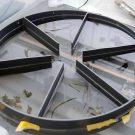
Three times a day, water samples are taken on the R/V POSEIDON using the CTD rosette. CTD stands for conductivity, temperature, and depth, which is determined by measuring the pressure. CTD sampling provides a vertical profile of the water and brings water from different depths to the surface. The CTD rosette on board consists of […]