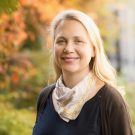
Meet Anu Reinart, a director of Estonian Space Research and Technology Center, Tartu Observatory. Her activities include governance of the basic research in the field of astronomy, also collaboration with industry for development of the applications in remote sensing and technology of satellites. The institute is also responsible for the University of Tartu study program […]
Sharing the caring: physical oceanographer Loreta Kelpšaitė Rimkienė
What is the nature of your work? I’m a senior researcher at the Marine Research Institute, Klaipeda University. My main interests are wave dynamics and their impact on the sandy coast. Career as a researcher. I got my first degree in physics. The undergraduate work on standing waves in semiconductors has evolved into the study […]
Moments of aftermath!
On January 8th we launched officially our Horizon 2020 Project „GoJelly“. The project is supported by the European commission to address marine litters by using jellyfish as an innovative and also new source for biotech-based researches which is unique worldwide in the structure we proposed. The main focus is to investigate in an anti-microplastic filter […]
Müll sammeln bei winterlichen Bedingungen
Trotz Minusgraden, Wind und teilweise Schnee machten sich das Sammel-Team des Geomars mit Kevin Schröder und Vanessa Herhoffer und der Kieler Forschungswerkstatt mit Dennis Brennecke, Tim Kiessling und Lukas Pott auf den Weg um die Strände an der Ostseeküste auf Mikro- und Makroplastik zu beproben. Um zu bestimmen wieviel Mikroplastik sich an den Stränden der […]
Die Kieler Plastikpiraten bei der Kinder- und Schüleruni
Gemeinsam mit dem Exzellenzcluster „Ozean der Zukunft“ laden wir Euch, Schülerinnen und Schüler von acht bis zwölf Jahren, zur Kinder- und Schüleruni ein. Am 21. März 2018 berichten Wissenschaftlerinnen und Wissenschaftler der Kieler Forschungswerkstatt über das Citizen Science Projekt “Plastikpiraten“. Der Vortrag beginnt um 16 Uhr und dauert rund 60 Minuten. Für die Eltern gibt […]
From the Canary Islands to Crete: sailing the Mediterranean straits, Part II
Bottlenecks – part II (read part I here) In our final blog we will re-capture our journey through the Mediterranean as it is not very often that one gets to travel from one end almost to the other. The Mediterranean is unique because of its numerous passages and straits. These maritime bottlenecks also characterized our […]
POS520: Exciting Discoveries / Spannende Entdeckungen
Oceanographic pioneer Maurice Ewing is reported to have advised his students that the key to discovery is to take a new instrument to a place where no one has explored before. The midwater research conducted off the Cape Verde Islands during Poseidon Cruise 520 is a fine example of that research philosophy. The unique combination […]
POS520: My dive into the deep / Mein Tauchgang in das unendliche Blau
by Nuno Vieira (INDP) During POS520 I help my German colleagues to collect environmental data with a CTD and water sampler rosette. I filter seawater samples taken in different depths to determine its oxygen content, and I assist in operating the Microstructure Probe which is used to profile the vertical current structure of the ocean. […]
From the Canary Islands to Crete: sailing the Mediterranean straits, Part I
Bottlenecks In our final blog we will re-capture our journey through the Mediterranean as it is not very often that one gets to travel from one end almost to the other. The Mediterranean is unique because of its numerous passages and straits. These maritime bottlenecks also characterized our journey, but luckily mproved to be the […]
POS520: Searching for traces in the open ocean / Auf Spurensuche im offenen Ozean
(Deutsche Version unten) Our cruise on the RV POSEIDON slowly comes to an end and today is the last day of sampling. My task during this cruise is sampling environmental DNA (eDNA). eDNA is defined as genetic material obtained directly from environmental samples, in our case water samples of different depths, without any obvious signs […]