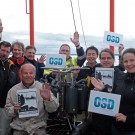
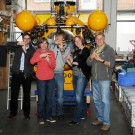
It’s been almost a week that we couldn’t share anything, but we had very science related(!) reasons: There was a shift change of Master’s students on Tuesday in KOSMOS Town. We (Rafael, Shawn, Dorthe, Serra) were warmly welcomed to this big KOSMOS Family! Luckily for us, end of the same week was the middle of […]
Navigators Zwischenbericht: Nein, ich bin kein Delfin-Experte!
Aufmerksame Leser haben vielleicht (hoffentlich…) bemerkt, dass am vergangenen Freitag der Wochenbericht des OceanNavigator-Blogs ausgefallen ist. Das hatte einen einfachen Grund: Es hätte zu viel zu berichten gegeben. Oder anders ausgedrückt: Wir waren voll im Stress. In so einer Situation wäre der Wochenbericht natürlich besonders spannend. Aber dann ist es leider auch so, dass die […]
Our Ocean Instruments
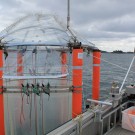
What are the instruments scientists used for? It may be mysterious to most of people. Today, let’s get a short impression by going close into a field study of ocean acidification. KOSMOS It is a close system. KOSMOS is like a floating iceberg. Don’t be misled by its part above water. In fact, the total […]
The core parameters – Filtration as a mission!
We (the girls from the filtration lab) are one team of several here at Espeland Marine Station near Bergen. We produce data that are the baseline for many other experiments conducted in this facility – oh dear! But what is filtration all about? Just imagine: we basically do the same everyone does in the morning […]
Top predators
In KOSMOS science meetings, information about the different levels of the food web are normally presented in succession from the smallest to the largest individuals. Last time, after we had talked about the pico-eucaryotes, phytoplankton, zooplankton, apendicularians and fish larvae, I was asked about the journalists. And I like thinking of them as top predators […]
Croeso i Gymru – From the country of castles and sheep
The first team blog of the new project comes from Sonia Morón and Sebastian Bicking. We are in Menai Bridge for 6 weeks now and acclimated to the Welsh weather very well. Actually, we were surprised by the marvellous, good weather here, since we expected rain or fog most of the time. Different from previous […]
Kräne und Kultur
Wie bereits erwähnt hatten wir am Wochenende Landgang, dieses Jahr stand Polen mit der Stadt Gdynia bei Danzig auf dem Plan. Nach einer Woche auf See freuen sich immer alle auf ein bisschen Auslauf. Andere Leute, mehr Platz, Boden der nicht schwankt, Vögel und Bäume. Von letzterem war zunächst allerdings nicht besonders viel zu sehen, […]
Beiboot
Es ist etwas Zeit vergangen seit dem letzten Blogeintrag, am Wochenende hatten wir Landgang und waren mit Erkundungen an Land beschäftigt, aber davon später mehr. An dieser Stelle wollen wir zuerst vom Ende der letzten Woche berichten: Am 21. und 22.05 waren wir im Bongo-Grid unterwegs, eine Reihe von Stationen bei denen nur Plankton gefischt […]
Are herring kids afraid in the dark?
Looking in the egg-incubators since the day we put them into the mesocosms, you could see pairs of eyes staring back at you. Then suddenly it got less and less, fortunately not unexpected, since they were hatching just as calculated by the temperature they experienced over time. Signs for first hatching could already be seen […]
KOSMOS 2015 presentation at IMR
What’s going on at the Espeland Marine Biological Station? What are these orange constructions in the Raunefjord for? And why do we have to care about ocean acidification? In his Hjort Guest Lecture, Prof. Ulf Riebesell from GEOMAR gives a brief overview of the present state of knowledge about ocean acidification, highlights some deficits in […]