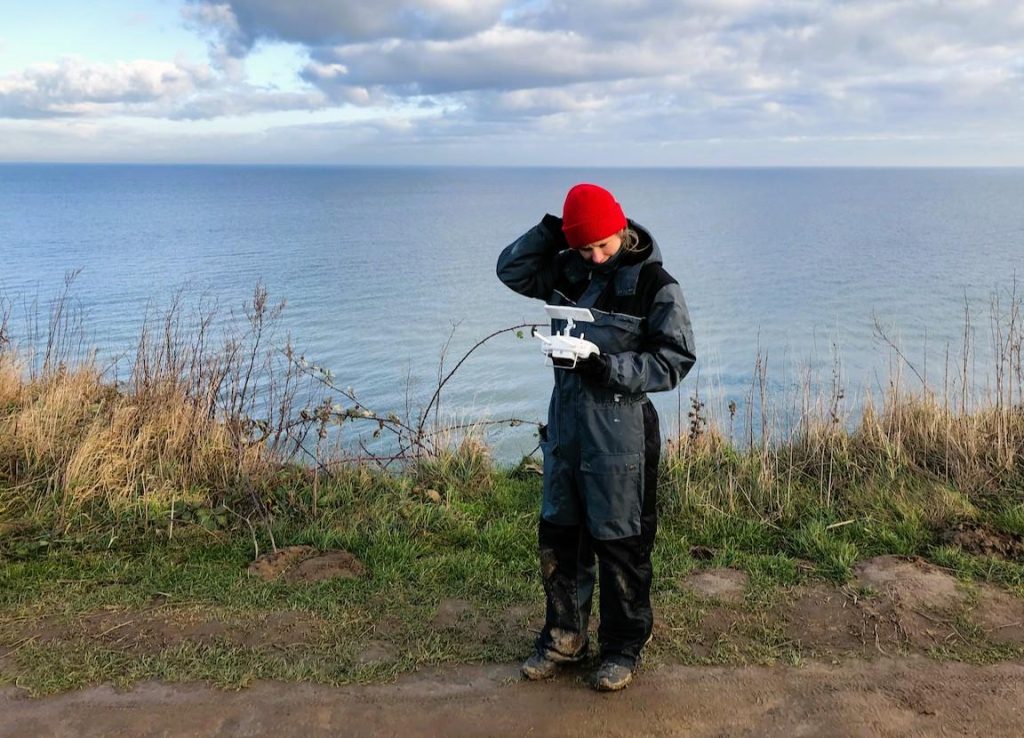
As a marine scientist working in the Baltic Sea area, summers are usually reserved for fieldwork: excursions to cliffs and beaches, research cruises with FK Littorina, and diving campaigns. Winters, on the other hand, are meant for processing and analysing the huge amounts of data collected during summer and for preparing the next field season.
That’s how it usually works, right? Well. As a PhD student researching cliff erosion processes, things can be a bit different. At least they were for me.
Why winter matters (unfortunately)
Cliff erosion is mainly driven by forces such as wind, waves, and high water levels. In other words: during summer there is often not much to see, while the big changes happen during the stormy winter season. So if you want to understand erosion processes, winter is not optional. Practically, it means: fieldwork all year round.
For someone like me, who genuinely enjoys fieldwork, that sounds like good news. But there is always a but. To be honest, winter fieldwork at the Baltic Sea coast can be tricky. And sometimes it just really, really sucks.Here are two winter fieldwork experiences I absolutely do not recommend
(but can luckily laugh about today).
The drone incident
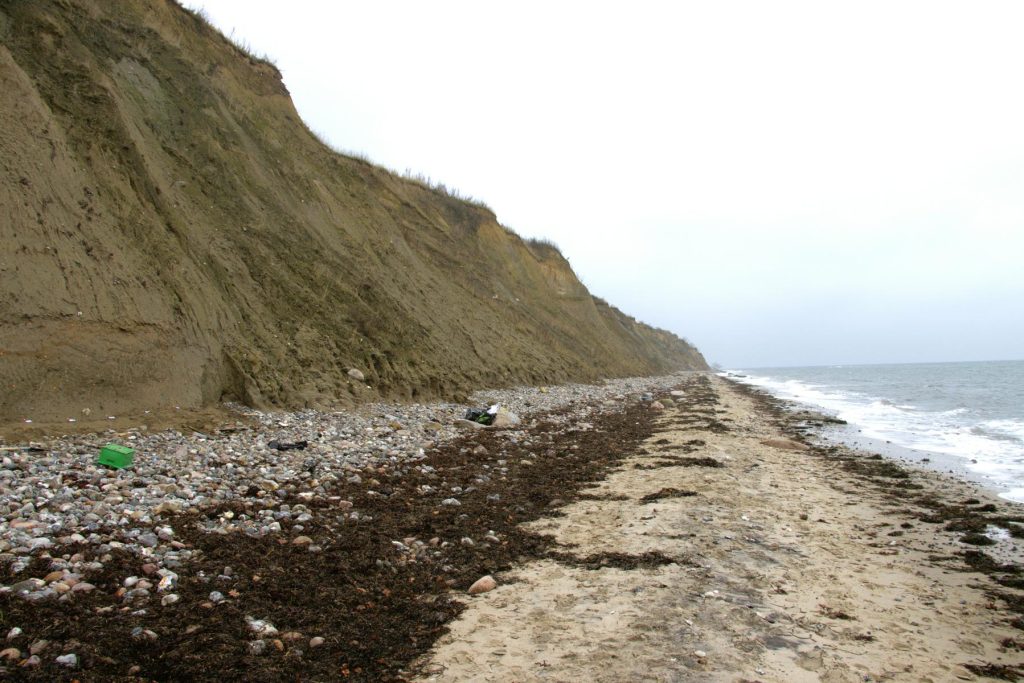
One of my main tasks during my PhD was to locate and quantify erosion by comparing 3D models of a specific cliff section. Once a month, I drove to the cliff at Stohl and let “Dronita”, the drone of our working group, do her thing. (In my defence: I didn’t give her a name or a gender. But now it is what it is.)
Following pre-planned flight paths, Dronita flew over the cliff section and took hundreds of photos from different heights and angles. From these images, I created a time series of high-resolution 3D models, allowing me to see exactly where material was eroding from the cliff and where sediment was being deposited.
In summer, this worked beautifully. With the start of autumn and winter, however, survey conditions became… challenging: too windy, too rainy, too foggy.
The almost perfect forecast
I still remember how excited I was when the weather forecast finally announced sunny and calm conditions. That temperatures had dropped below zero didn’t bother me at that moment. I packed up Dronita, put on sunglasses, and headed off to Stohl – completely unsuspecting. The fact that my car struggled to start that morning due to a low battery should have been a warning, though.
Already in summer, my surveys were limited by the drone’s battery capacity. In winter, when it’s roughly 25 degrees colder, battery performance drops dramatically. Usually, that’s not a problem: the drone warns you early enough to land safely and change batteries. Usually.
When the hardware tries to save itself
On that very cold day at the cliff, I clearly overestimated the battery – and apparently Dronita did too. Midway through the survey, my remote control started beeping and vibrating: low battery warning. No problem, I thought, and initiated my usual manoeuvre to fly the drone back to me. She was only meters away.
And then things escalated.
The battery level dropped so fast that Dronita suddenly switched into full emergency mode. She ignored my frantic button-mashing on the remote, climbed up to 100 meters altitude, and tried to fly back to her take-off point with the last bit of energy. The problem? That point was at the complete opposite end of the cliff section.
Now I started panicking too.
Dronita was rapidly flying out of sight, and I wasn’t sure whether she would make it to her destination – or simply drop from the sky. So I ran after her. In my head, I already prepared apologies for having destroyed a several-thousand-euro drone. After an 800-meter full-on sprint, I finally reached her landing spot. There she was. Peacefully sitting near the edge of the cliff. She was completely fine. And so was I – after a few minutes of heavy breathing. But, honestly, I’ve had better days. (Not so) fun fact: because the cliff was partly covered in snow that day, the data were unusable for my research anyway. In Conclusion: an absolutely nerve-wracking and completely useless day. Don’t try this at home.
Save money for the gym – dig at frozen cliff instead
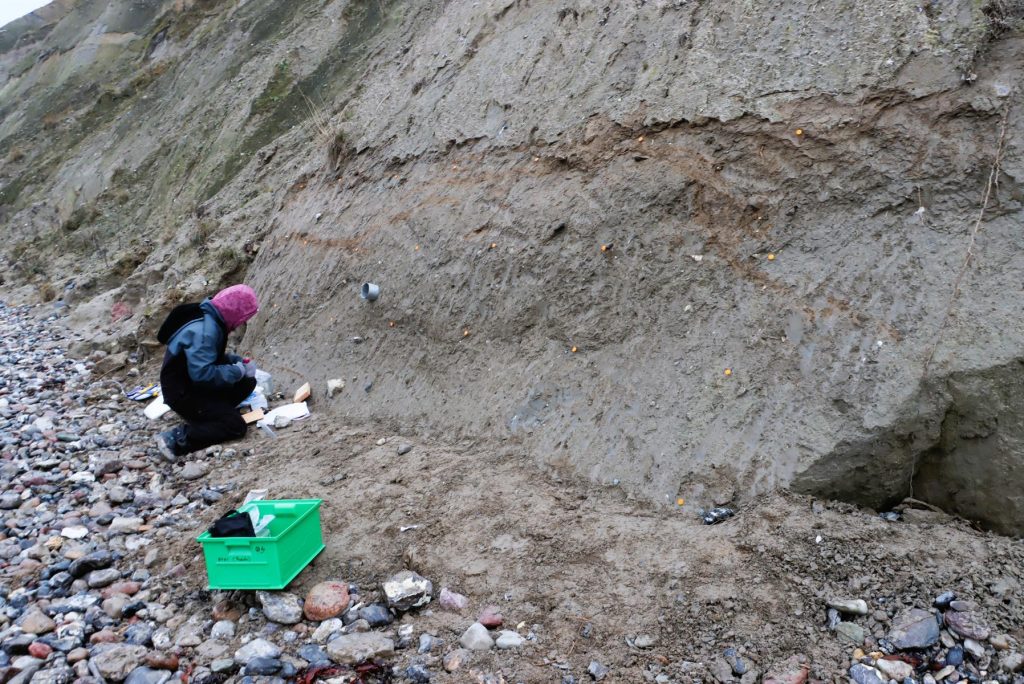
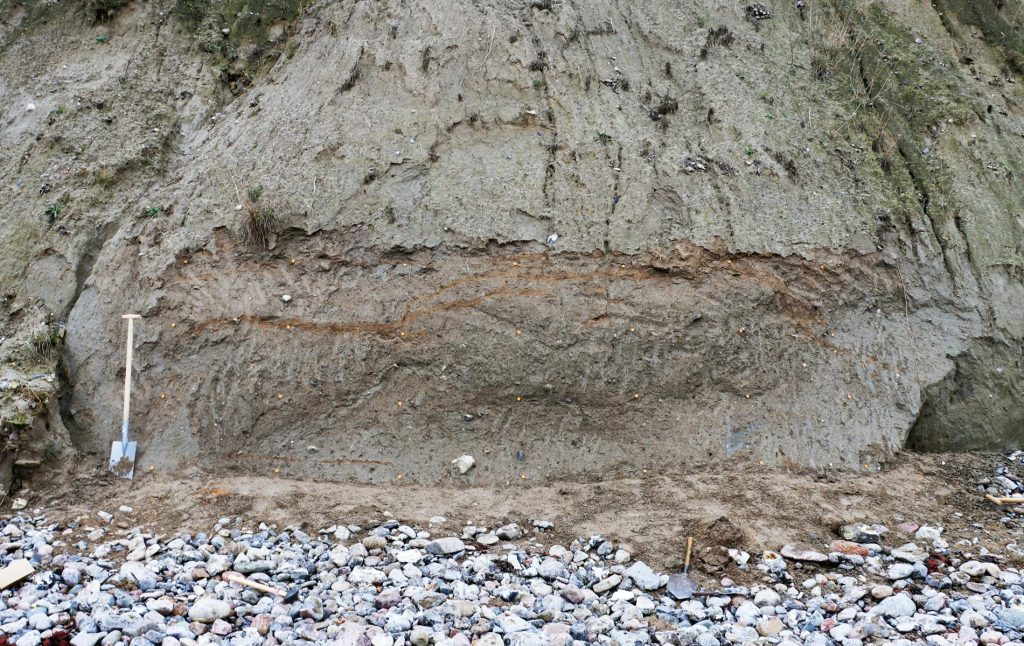
Ok, I got one more – not quite as useless but still not recommended. It is about digging a cliff profile for geological analyses in winter. At least this time. I wasn’t unaware of the challenge. It was mainly bad timing.
The geological and sedimentological analysis of the Stohl cliff was supposed to be part of a student’s master’s thesis and, therefore, time-sensitive. So she and I did what had to be done.
Why this was a bad idea
Even during summer, digging a cliff profile at most locations along the Baltic Sea coast is exhausting. The cliffs mainly consist of glacial till: very dense, compacted sediment containing all grain sizes – from tiny clay particles to large boulders. Obviously, the material becomes even harder when it is freezing outside.
After several hours, many swear words and gasps of exhaustion, we eventually managed to dig a profile of roughly 1.2 by 3 metres.
The silver lining
At the end, the hard physical work didn’t kill us but made us stronger (quite literally) and actually kept us warm despite the ice-cold wind at the coast. We managed to collect all required data, and the master’s student successfully analysed the samples to finish her thesis.Still, my recommendation to every student remains this: If your thesis requires this type of fieldwork, don’t start it when winter is coming.
Tanita
Love it 😍