By Joelle Habib (Laboratoire d’Océanographie Villefranche)
When I was a kid, I wanted to be a photographer. I still do, actually. But somewhere along the way, science intervened, and it gave me something I never expected: the chance to be an underwater photographer. Not the National Geographic kind who chases polar bears or waits weeks for a penguin to do something interesting. My subjects are smaller. Much, much smaller. I get to photograph the invisible life of the deep ocean, the tiny animals and sinking particles that most people never know exist. And the camera I use to do it descends to 6000 meters below the surface.
This instrument is called the UVP, or Underwater Vision Profiler. On this cruise, we deployed a UVP6 attached to the CTD rosette, profiling down to 4000 meters depth. The instrument activates automatically once its pressure sensor detects it is moving downward, takes up to 20 pictures per second all the way to the bottom of the cast. But before we talk about what the UVP gives us and why it matters, we need to talk about what it actually photographs: zooplankton and particles.
If you have ever watched SpongeBob SquarePants, you already know a zooplankton. Sheldon J. Plankton, the tiny villain who is perpetually trying to steal the Krabby Patty formula, is one. And funnily enough, the most abundant zooplankton across all the world’s oceans, is indeed this small crustacean: the copepod.
Here is the basic idea: a plankton is any organism that drifts with the ocean currents rather than swimming against them. If it photosynthesizes like a plant and contains chlorophyll pigments, it is a phytoplankton. If it is an animal, it is a zooplankton. A jellyfish is a zooplankton, just a very large one. Zooplankton graze on phytoplankton, on each other, and on anything small enough to eat. Now for the process that connects all of this to climate, to carbon, and to why we are out here on a research vessel in the middle of the equatorial Atlantic: the biological pump.
The biological pump is the ocean’s mechanism for pulling carbon out of the atmosphere and locking it away in the deep sea. Here is how it works: phytoplankton at the surface absorb CO₂ from the atmosphere and convert it into organic matter through photosynthesis. When they die, or when zooplankton eat them, defecate, excrete, and die themselves, all of that organic carbon does not simply disappear. It becomes marine snow! Yes, it snows in the ocean!!! Marine snow consists of a continuous rain of particles, aggregates, fecal pellets, shed exoskeletons, … Every flake of marine snow is a fragment of life that once existed at the surface, now on a one-way journey into the deep. This is the gravitational pump, one of the most important carbon sinks on Earth, and it is one of the pumps that the UVP was built to observe.
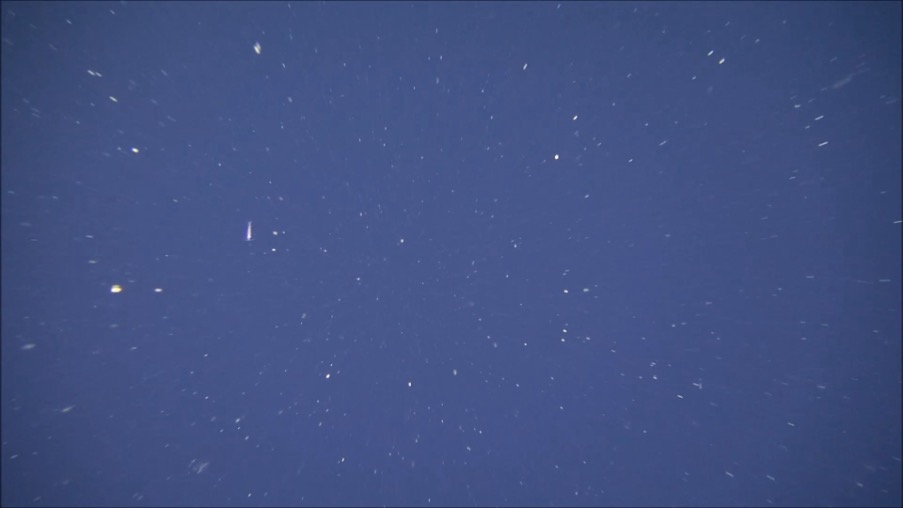
Marine snow seen by PELAGIOS (Pelagic In situ Observation System) in the Tropical Atlantic; 23°W; 100 m depth. Photo Credit: Henk-Jan Hoving
So why image and count particles rather than simply collecting water samples or relying on sediment traps? Because the abundance and size distribution of marine particles are two of the major factors controlling biological carbon sequestration in the ocean, and traditional methods cannot capture them at high resolution throughout the water column. Vertical profiles of particle images can reveal the processes that determine particle size, type, and distribution, and combined with information on carbon content and sinking velocity, they provide high-resolution information on how the biological pump operates at depth. The UVP allows for the remote collection of large datasets on particle abundances and their size distributions, enabling much higher spatial and temporal resolution than traditional methods. But particles are only one part of the story, the UVP also tracks zooplankton and their daily migrations: every night, zooplankton rise from the deep to feed near the surface, then sink back down before dawn, actively carrying carbon into the deep ocean in their own bodies. Without imaging tools like the UVP, this active carbon flux is nearly impossible to quantify.
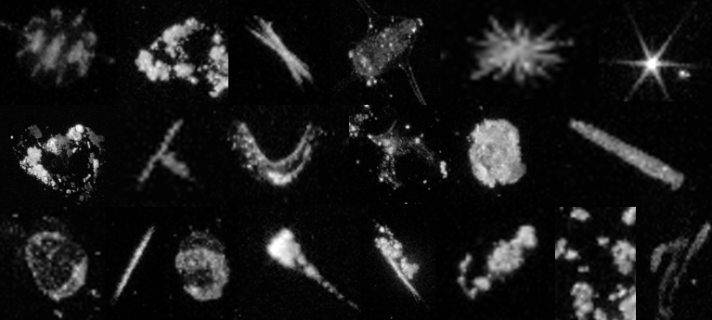
Each image you see here was taken in complete darkness, somewhere between the ocean surface and 4000 meters below. The UVP6 illuminates a tiny volume of water, with a single red flashing light, capturing only the particles and organisms that happen to drift through that small window at that exact moment.
The instrument captures everything larger than 100 micrometers, roughly the width of a human hair. In the images you will see two types of things: fuzzy, irregular blobs of varying sizes: Marine snow aggregates. And more defined, structured shapes, sometimes with appendages, antennae, or transparent shells. Those are the zooplankton.
Every image is a small portrait of a world that already existed long before we had the tools to see it. I am so lucky I am able to see parts of that hidden life in this lifetime.