English version below
Wenn man an Chemie denkt, denkt man wahrscheinlich schnell an explodierende Gläser, ätzende Säuren und verrückte Professoren, aber nicht an den Ozean. Hier an Bord wird unsere Wissenschaftsteam auch von zwei chemischen Ozeanographen begleitet, Tobias Steinhoff und Kristin Kampen.
Den beiden habe ich die Frage gestellt, „Was findet ihr an der chemischen Ozeanografie spannend?“: Es ist unglaublich interessant, was es alles an unsichtbaren Prozessen im Meer gibt, die unser aller Leben beeinflussen: In der chemischen Ozeanographie untersuchen wir, wie sich chemische Bestandteile im Meer verhalten, z.B. wie sich gelöste Gase (wie CO₂ und Sauerstoff), Nährsalze (wie Nitrat und Phosphat), Spurenmetalle und organische Verbindungen im Meerwasser verhalten und verteilen. Der Ozean nimmt CO₂ auf, produziert Sauerstoff und transportiert Nährstoffe durch den Ozean und überall wirken chemische Prozesse mit. Diese Zusammenhänge zu verstehen ist Grundlage unserer Arbeit.
Auf unserer Ausfahrt in der Labradorsee nehmen sie Seewasserproben und extrahieren gelöstes organisches Material (DOM). Dies umfasst alle organischen Verbindungen, die im Meerwasser gelöst sind, also nicht als Partikel vorliegen. Das sind zum Beispiel Zucker, Aminosäuren, Fette und komplexere Moleküle, die aus abgestorbenen Organismen, Ausscheidungen von Meereslebewesen oder dem Abbau von Algen stammen. Als einer der größten Kohlenstoffspeicher spielt DOM eine zentrale Rolle im marinen Kohlenstoffkreislauf. Die Labradorsee ist eine der wichtigsten Regionen für die Bildung des North Atlantic Deep Water (NADW). Oberflächenwasser sinkt in die Tiefe und nimmt dabei DOM mit. Das NADW verteilt dieses Material dann über Jahrhunderte durch die Weltmeere und entzieht so der Atmosphäre langfristig Kohlenstoff. Zusätzlich werden kontinuierliche Messungen von pCO₂/O₂ im Oberflächenwasser während der Fahrt durchgeführt, um sich den Austausch von CO₂ zwischen Ozean und Atmosphäre anzuschauen. Viele Prozesse sind hierbei immer noch nicht vollständig verstanden, wie z.B. der Gasaustausch bei hohen Windgeschwindigkeiten.
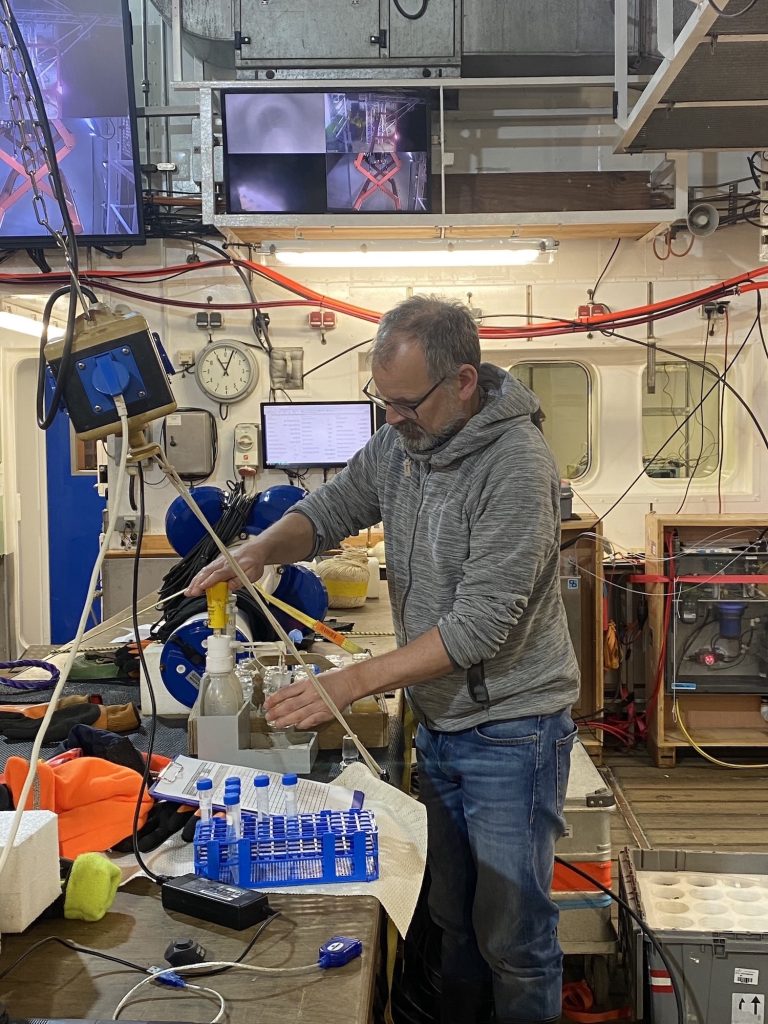
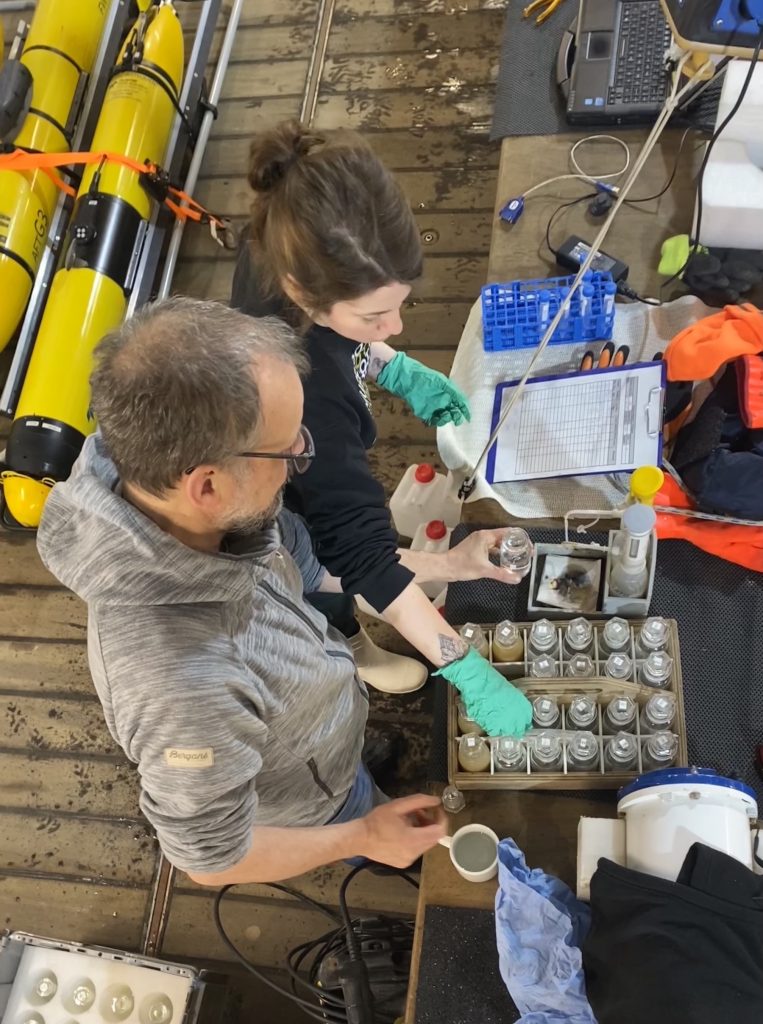
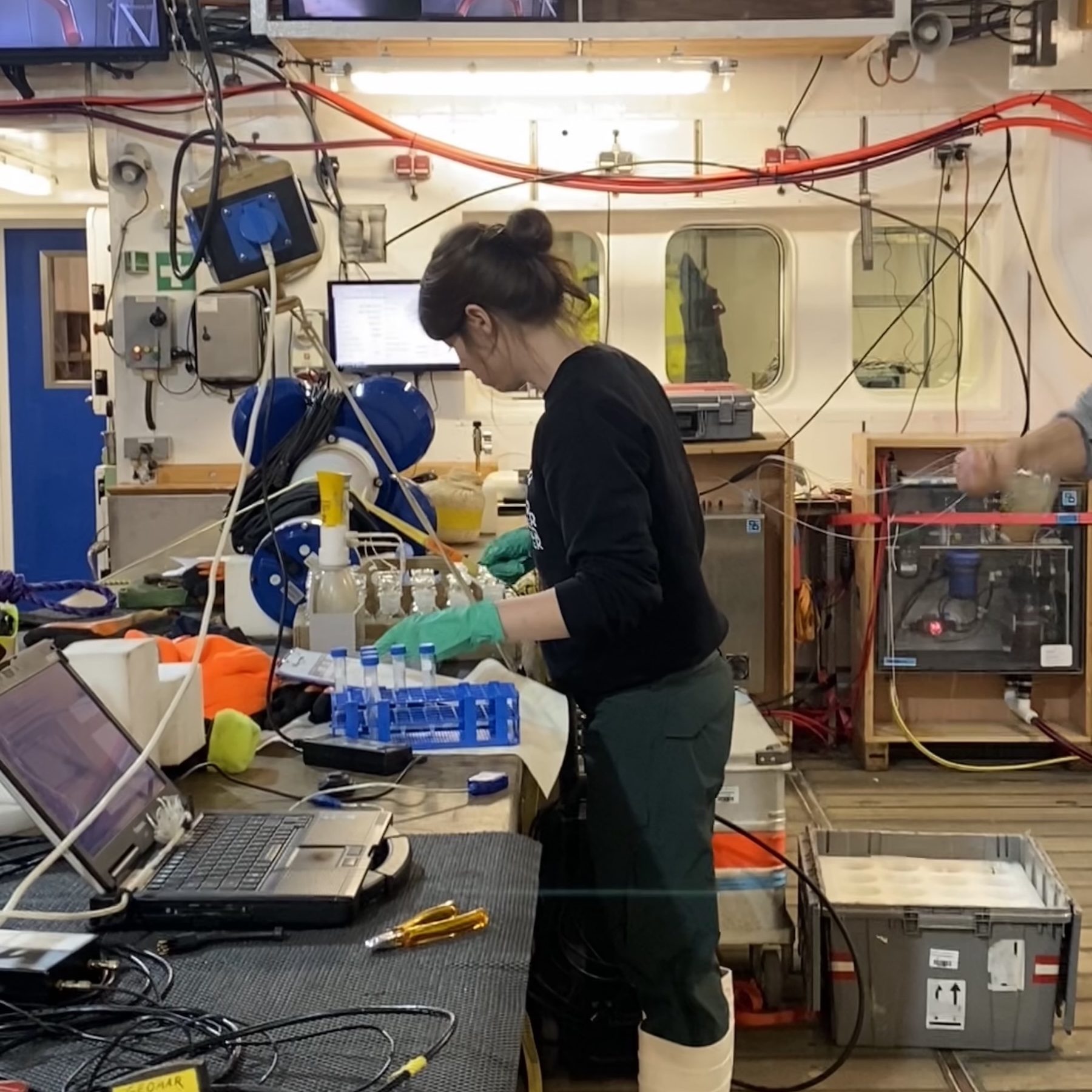
Da es hier auf See, besonders in dieser Region, oft sehr stürmisch zugeht, ist kein Geheimnis und es geht natürlich besonders in einem Chemie Labor dann doch mal etwas zu Bruch. Wie läuft diese Arbeit also bei 11bft und 6 Meter Wellen ab. Wasserproben müssen meist innerhalb von 24 Stunden verarbeitet werden. Da kann man nicht immer Rücksicht auf die Wetterbedingungen nehmen. Einige Arbeiten werden immer noch nasschemisch gemacht und unter Einsatz von Glasmaterial. Sowohl das genaue Abmessen von Reagenzien als auch das Zusammenhalten der Glasware ist nicht immer einfach bei einem rollenden Schiff (und auch nicht immer erfolgreich). Man versucht zwar den doch dann plötzlichen Bewegungen des Schiffes entgegenzuwirken und alle Proben Behälter, Kisten und Flaschen zu sichern. Man wird aber dann doch mal von einem umkippenden Mülleimer überrascht und die noch neu verpackten Plastikröhrchen oder andere Fliegengewichte im Regal finden bei der einen oder anderen Welle ihren Weg auf die gegenüberliegende Seite im Labor. Dazu kommt, dass beim Arbeiten mit chemischen Stoffen und Proben doch des Öfteren beide Hände für die Arbeit gebraucht werden. Wird man dann allerdings von einer Welle überrascht, erfordert das Festhalten mit der dritten Hand (Fuß falls man schnell genug ist), einiges an Bauchmuskeln.
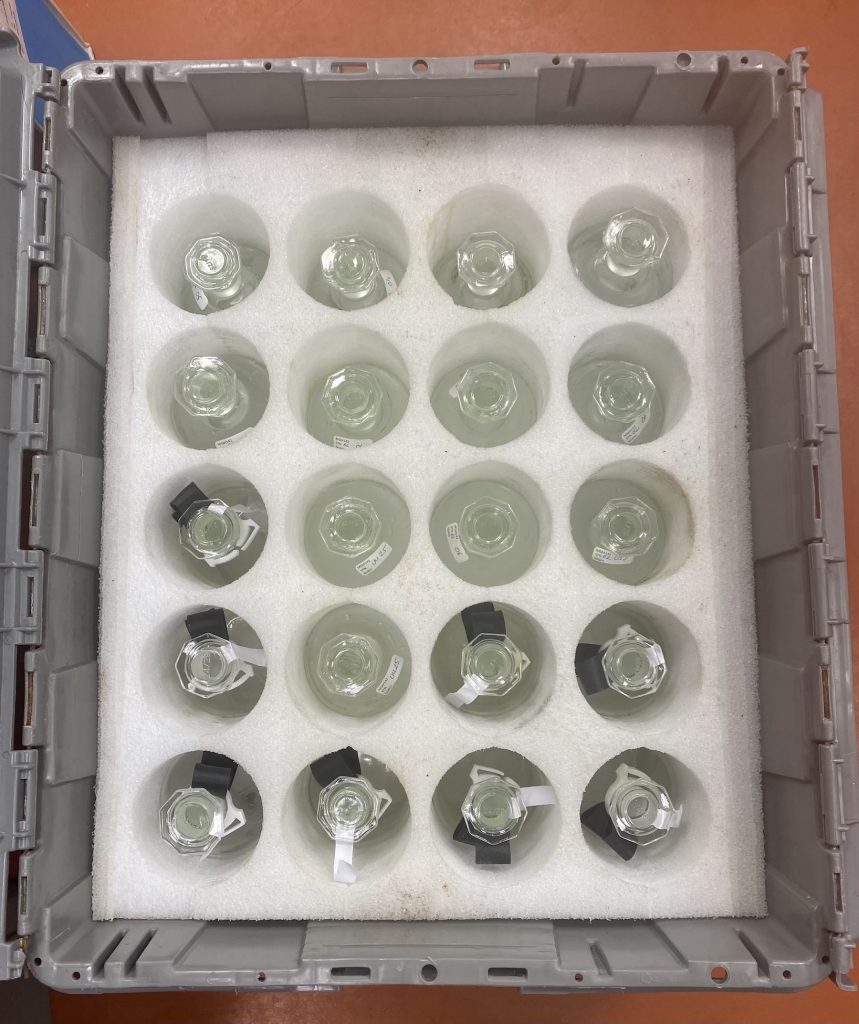
Foto: Julia Pelle
Das Besondere an der Arbeit auf See ist, dass man neben der alltäglichen Schreibtischarbeit auch praktisch arbeiten kann. Dabei ist man auf die enge Zusammenarbeit mit seinen Kollegen angewiesen und lernt sie dabei viel besser kennen. Zusätzlich sind auch viele andere Forschungsbereiche mit an Bord, wodurch es einen spannenden Austausch zwischen den einzelnen Gruppen gibt.
Zum Schluss hier noch ein kleiner Tipp am Rande von unseren Chemikern und für deine erste Forschungsseereise: Laschen, laschen, laschen und immer ein Ohr am Bordfunk: Der Arbeitsplan ist bei den Wetterbedingungen eher ein Vorschlag und kann sich stündlich ändern (die nächste CTD Station ist immer um die Ecke).
Chemistry: Making the Invisible Visible
When you think of chemistry, you probably quickly imagine exploding glassware, corrosive acids, and crazy professors, but not the ocean. Here on board, our scientific team is also accompanied by two chemical oceanographers, Tobias Steinhoff und Kristin Kampen.
I asked them the question: “What do you find exciting about chemical oceanography?”
“It is incredibly fascinating how many invisible processes exist in the ocean that influence all of our lives. In chemical oceanography, we study the fate of various chemical components in the ocean: for example, how dissolved gases (such as CO₂ and oxygen), nutrients (such as nitrate and phosphate), trace metals, and organic compounds behave and are distributed in seawater. The ocean absorbs CO₂, produces oxygen, and transports nutrients through complex cycles, including chemical processes. Understanding these relationships forms the basis of our work.”
During our expedition in the Labrador Sea, they collect seawater samples and extract dissolved organic material (DOM). This includes all compounds dissolved in seawater, meaning they are not present as particles. Examples include sugars, amino acids, fats, and more complex molecules that originate from dead organisms, excretions from marine life, or the breakdown of algae. As one of the largest carbon reservoirs, DOM plays a central role in the marine carbon cycle.
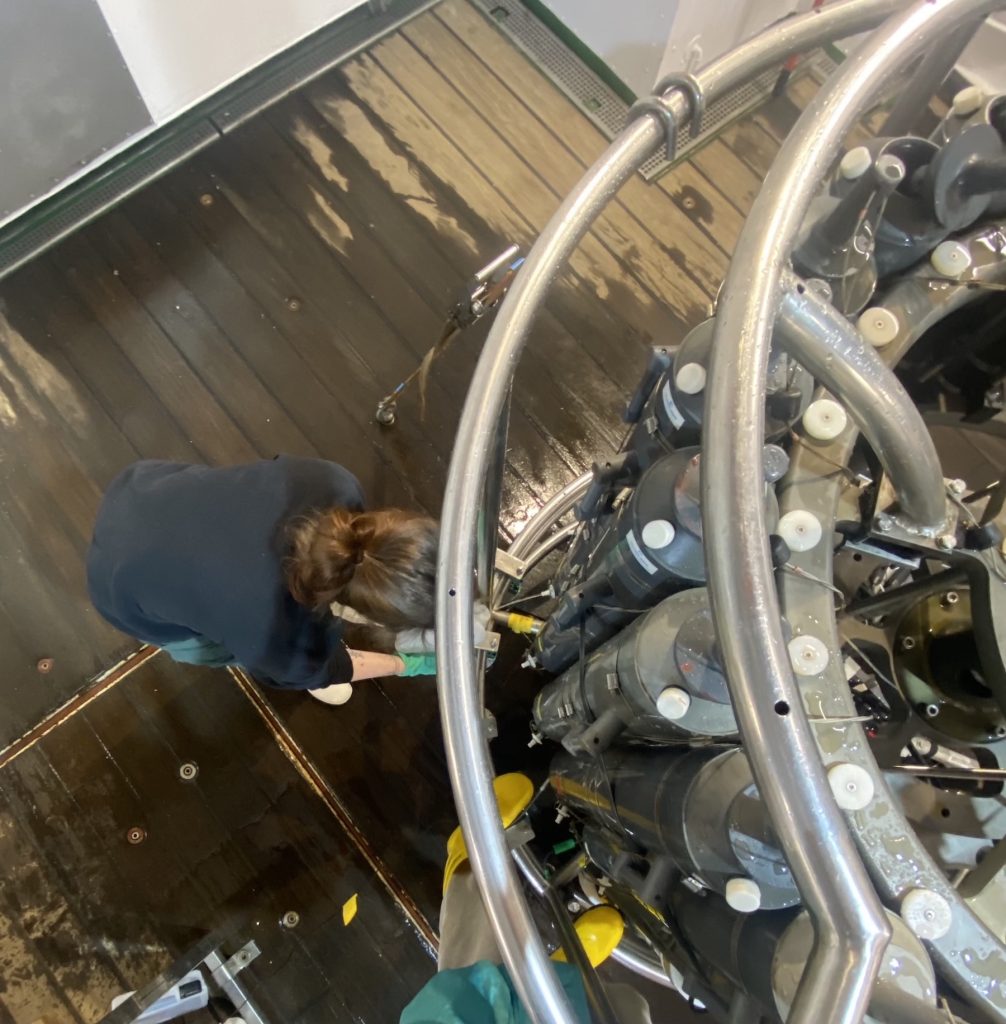
The Labrador Sea is one of the most important regions for the formation of North Atlantic Deep Water (NADW). Surface water sinks into the depths, carrying DOM with it. NADW then distributes this material throughout the world’s oceans over centuries, thereby removing carbon from the atmosphere over the long term. In addition, continuous measurements of pCO₂ and O₂ in surface water are taken during the voyage to study the exchange of CO₂ between the ocean and the atmosphere. Many processes involved are still not fully understood, such as gas exchange under high wind speeds.
It is no secret that conditions at sea especially in this region are often very stormy, and in a chemistry lab, things can occasionally break. So how does this work at 11 Beaufort and 6-meter waves? Water samples usually need to be processed within 24 hours, so you cannot always take weather conditions into account. Some work is still done using wet chemistry and glass equipment. Accurately measuring reagents and holding glassware steady is not always easy on a rolling ship (and not always successful). Although efforts are made to counteract sudden ship movements and to secure all sample containers, boxes, and bottles, you may still be caught off guard by a tipping trash bin, and newly packaged plastic tubes or other lightweight items can suddenly fly across the lab with the next wave.
On top of that, when working with chemicals and samples, both hands are often needed. If a wave hits unexpectedly, holding on with a “third hand” (your foot, if you are quick enough) requires quite a bit of core strength. What makes working at sea special is that, alongside everyday desk work, you can also do hands-on work. This requires close cooperation with colleagues, allowing you to get to know them much better. In addition, many other research disciplines are on board, which creates exciting exchanges between different groups.
Finally, here is a small tip from our chemists for your first research expedition: strap everything down, strap everything down, strap everything down and always keep one ear on the ship’s radio. The work schedule is more of a suggestion under these weather conditions and can change hourly (the next CTD station is always just around the corner).