What happens on a research vessel when the weather is bad? We have been quite lucky with the weather and sea conditions so far. The average day has mostly consisted of blue skies, hardly any swell or wind, and the clouds that have appeared in the sky from time to time have looked more like decoration for the scenic backdrop than harbingers of precipitation. It is only towards the end of the voyage that the wind and waves pick up speed significantly. But that’s nothing compared to weather conditions that make almost any work on deck impossible and in which everyone, except the experienced members of the crew, prefers not to leave their cabins. Fortunately, such dramatic conditions are more likely to occur in the middle of a storm over the Atlantic, and we in the Aegean Sea, surrounded by islands that protect us from the wind and weather, don’t really have to worry about ending up in such a situation.
However, it is still essential for work on the ship to obtain information about weather conditions such as wave height, wind direction and visibility. We get this from the two ship meteorologists, Frank Otte and Lutz Beckebanze, who are on board the FS METEOR. The two meteorologists are part of the German Weather Service (DWD) and part of a small group of experts on marine weather – in Germany, their members can be counted on almost two hands.
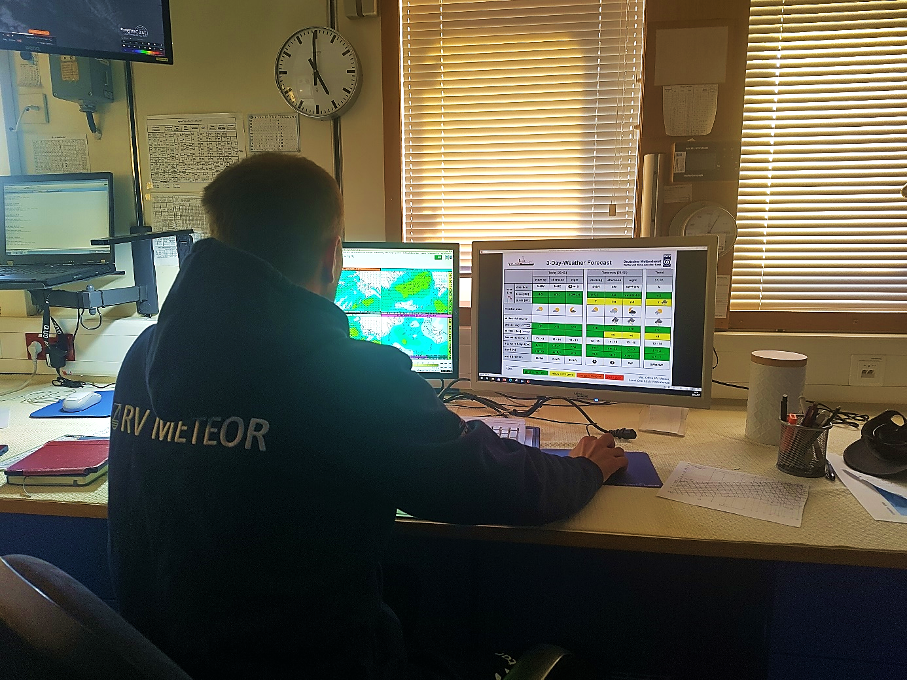
Frank has been working full-time as a ship meteorologist at sea for about ten years. He has frequently been on board the FS METEOR, but has also spent several months on the FS POLARSTERN in the polar regions of the world. For him, working on board here is a dream job, and his many years of experience are a great asset to us. Lutz is on board as a ship meteorologist for the first time. As an expert in marine weather, he was previously based in Hamburg, where he was responsible for producing marine weather charts and forecasts for the North Sea and Baltic Sea, and he is very much looking forward to his upcoming assignments at sea. The FS METEOR also has a weather station, which is maintained by the meteorologists. There, parameters such as precipitation, wind direction and speed, UV radiation and sunshine duration are measured directly. This data is particularly important because direct meteorological measurements above the water are rare – there are hardly any measuring stations in the middle of the sea.
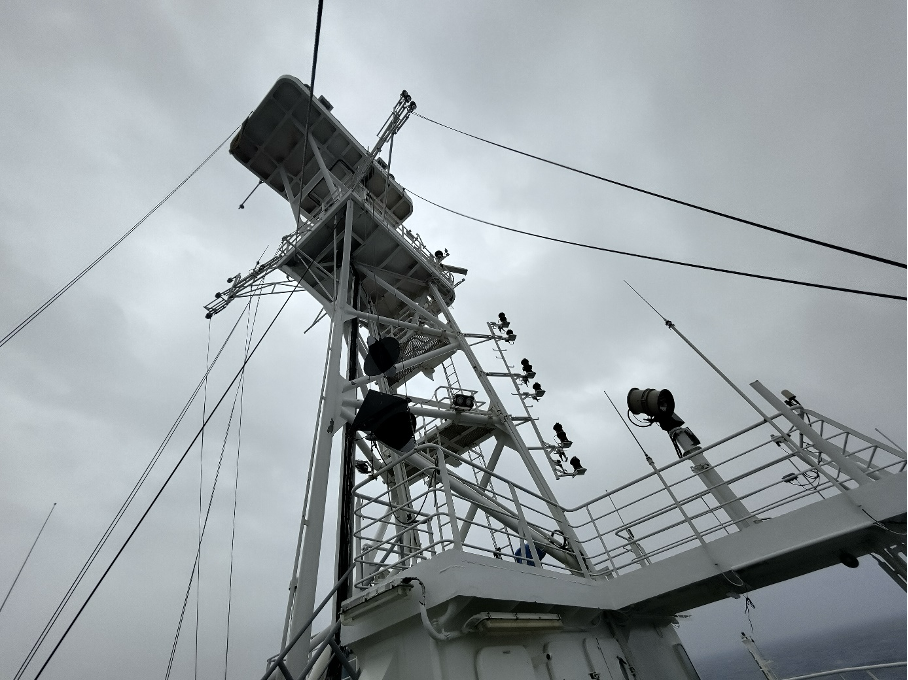
The working day begins at around 6 a.m. Every morning, a weather briefing takes place on the bridge – the two of them prepare the weather forecast in advance at the DWD office. The main focus is on assessing uncertainties, as there are many weather models. However, comparing these models and assessing which one is most likely to be correct is the task of meteorologists and requires in-depth background knowledge and many years of experience. Wave height and wind strength are particularly relevant for us in weather forecasting. When it comes to waves, a distinction is made between wind waves, which are generated locally by the wind, and swells, which are caused by distant weather conditions, such as low-pressure areas, and also generate waves in our area. A special feature is our position between the many different islands, which causes special wind effects and wave interference. However, there is almost always a sheltered area where measurements can be taken without any problems.
Slightly wavy greetings from the Aegean Sea
The M215 (MMC-3) team