A typical evening on our expedition is probably more relaxed than on many others. This is because most of our measurements require daylight, so most team members have an almost normal sleep pattern – unless it unexpectedly gets late in the laboratory, which can happen. Otherwise, in the evenings, you’ll find the team members sitting together playing cards, stargazing on deck, or having late-night discussions about tomorrow’s measurements. Or, of course, you might bump into them, already a little sleepy, in the corridor on their way to their cabins.
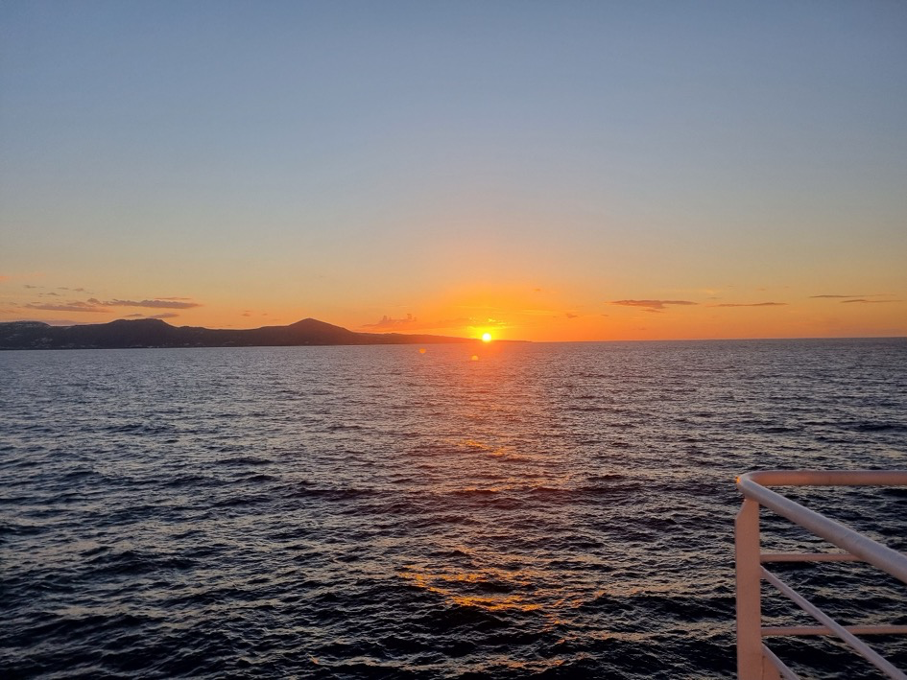
This applies to many, but not all: a select few turn night into day and make sure that everything runs smoothly while the others sleep.
Four-hour shifts are assigned on the bridge – day and night, the officers are on duty during their time slot to steer the ship and bring us safely to the next stop. For example, from 4:00 to 8:00 a.m. and again from 4:00 to 8:00 p.m., you are guaranteed to find the first mate Magnus on the bridge. To ensure that everything can be kept in view from the bridge in the dark, there are no lights on there either, and the room is pitch black. Those in charge can find their way around blindly, of course, so this is not a problem – as long as no one sneaks up on them. One of the first lessons you learn as a newcomer on the ship is to make yourself noticed early and clearly when you enter the bridge at night. Otherwise, you’ll quickly give the person on watch a good scare – thankfully, everyone on our trip takes the initial faux pas with humour, and scary ghosts learn quickly. Additionally, the bridge has a first-class coffee machine that sweetens the odd late or early hour.
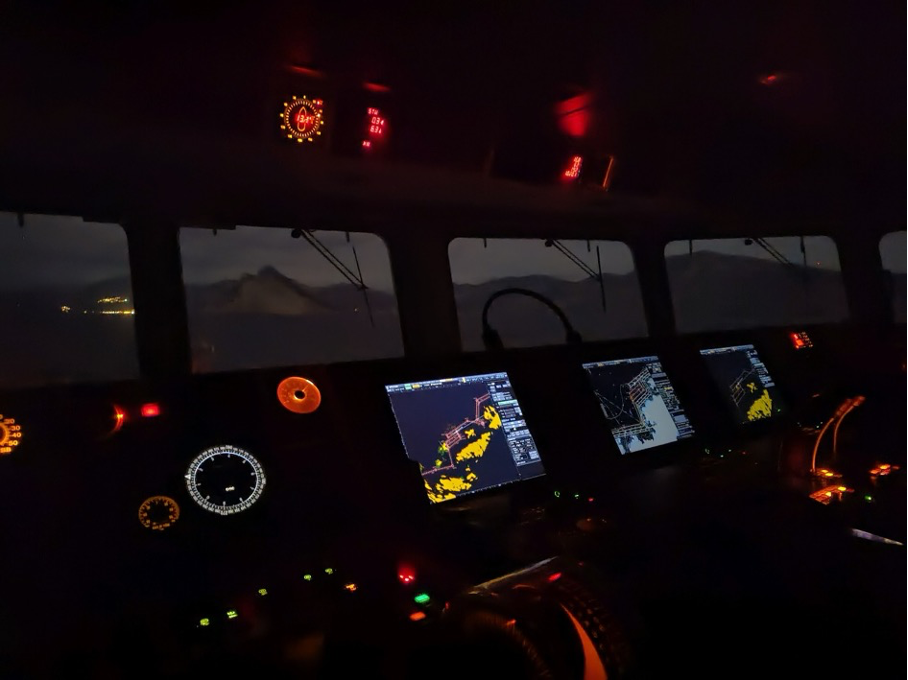
Who would dare to haunt the bridge at night? If something happens down on deck, the sailor on watch, Olaf, naturally informs the bridge. In the early hours of the morning, long before sunrise, cook Mike likes to drop by for a coffee. On the side of the scientific team, the members of the multibeam team are the main suspects. As mentioned in previous posts, hydroacoustics are the main focus of night-time measurements on the M215 (MMC – 3). The ship-based system is operated by a single person and provides us with data on the seabed surface, which can be monitored live on screen. The working group is led by PhD student Effrosyni Varotsou (Froso). By now, everyone has become a well-coordinated team and works together excellently at all hours of the day and night.
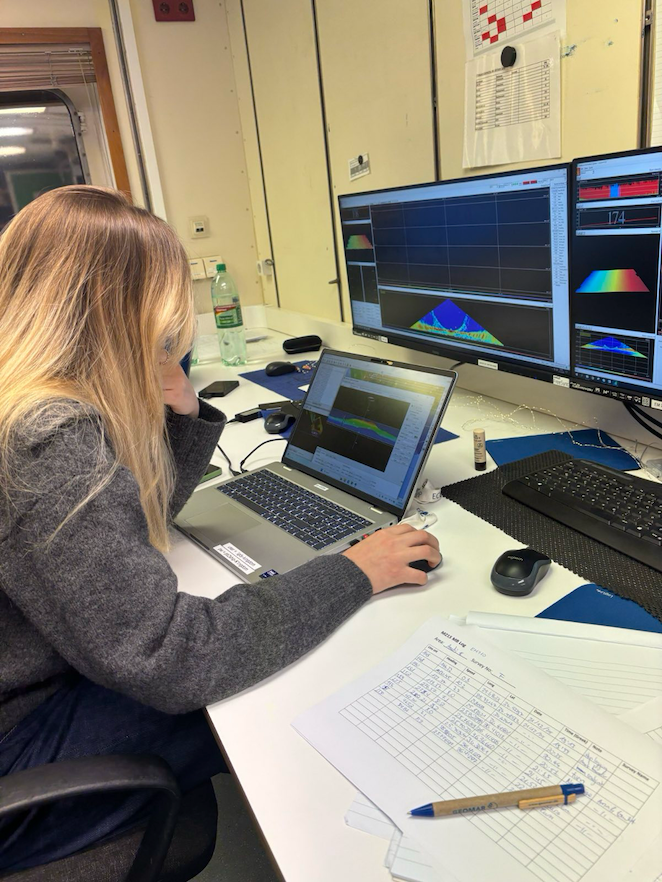
How does it work? From the underside of the ship, the multibeam sends out a wide fan of directed acoustic signals, also known as pings, in the high-frequency range many times per second. It measures the time it takes for each individual signal to be reflected back from the seabed to the measuring system and then calculates the water depth using the speed of sound, which is measured every few days specifically for the entire water column. The ship travels all night along a pre-determined route, which usually consists of many parallel lines at varying distances from each other. These have been discussed and planned in advance, taking into account many different factors such as water depth, distance from the coast, the direction of the slope, or simply the time available, which depends each day on when the daytime working groups complete their measurements. The overall aim is to shed light on previously uncharted areas as efficiently as possible, but without leaving any gaps. This can be very exciting when we are sailing over a fault or other interesting geological structures, but it is not uncommon for us to also map shallow water areas on this trip, which at first glance seem rather boring, but are of great use for many models, which are fed with the data collected after the trip. Even then, however, there is something strangely meditative about watching the screen during the watch, as ping after ping of new data appears, forming a rainbow-coloured topographical image.
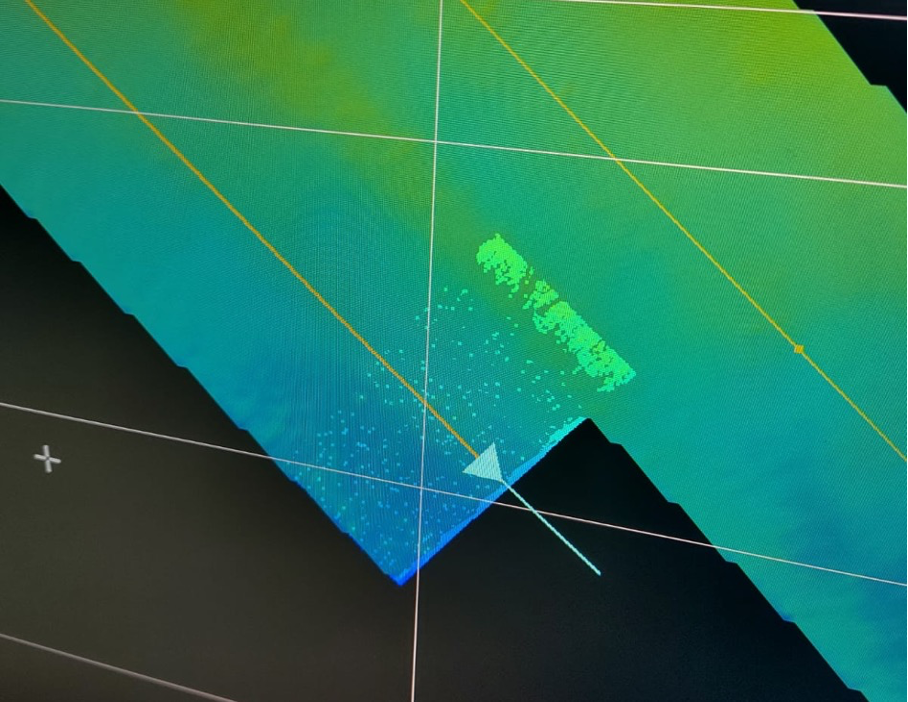
So what happens during an average night watch in the multibeam team? What goes through the minds of those on watch as they diligently log waypoints, plan lines, process data, and keep a constant eye on the system, which has briefly failed us during one or two measurements? Control is better than trust here; after all, we need the data to determine the areas of operation for our AUVs (Autonomous Underwater Vehicles) and the underwater video sled MOMO. Usually however, everything runs smoothly, and the only reason to visit the bridge is to add or postpone waypoints at short notice if the timing is not quite right. We asked the team members for their tips and tricks for a relaxed and entertaining night watch on the multibeam:
– Stare at the screen with fascination, only to realise when your watch is over that the hours have flown by (advantage: no chance of a system error going unnoticed; disadvantage: afterwards, you only dream of colourful seabed profiles)
– Snack like there’s no tomorrow. We are the best customers of the ship’s snack bar.
– Music is always good for keeping your eyelids and spirits up.
– Stop by the bridge and, with a bit of luck, you might even get a cup of coffee there.
Not to be forgotten is the watch on deck, which is organised in eight-hour shifts. From midnight to 8:00 a.m., you will find sailor Olaf there, making sure everything is in order. At night, there is also time for work such as painting or derusting – wherever there is light. This shift is the quietest of all on deck, especially on our voyage, where no measuring instruments are taken on or off deck at night. There is also always one person on watch in the engine room, because there, too, an eye is kept on everything to make sure that everything is working smoothly.
And so, the night passes, and the ship wakes up in the early hours of the morning. Breakfast is at 7:15 a.m., and the first measuring instruments go into the water at 8:00 a.m. at the latest.
Whatever time of day or night you read this article, we send you our best regards!
The M215 (MMC-3) team