In recent days, we have been spending a lot of time just off the coast of Santorini. The Greek archipelago of Santorini is the second main destination of our voyage, alongside the underwater volcano Kolumbo, and the RV METEOR can be spotted here at least every few days. The archipelago consists of the crescent-shaped main island of Thira and the smaller islands of Thirasia and Aprosini, which form a circle around a caldera flooded by the sea. At its centre are two volcanic islands, Palea Kameni and Nea Kameni. Santorini was formed by several volcanic eruptions in its past. The devastating eruption in 1620 BC destroyed most of the original island and flooded the caldera. Later eruptions formed the two volcanic islands and thus the archipelago as it exists today. The legacy of its volcanic origins is reflected in the image of the islands. For those of us who have not been here before, the view is breathtaking. The gentle black and red volcanic beaches and the high, venerable crater walls form an impressive contrast, and the towns we glimpse from the ship seem as rich in history as they are lively. No wonder Santorini has such an appeal to visitors from near and far!

On 21 December, we received a visit from representatives of the municipality of Thira in the caldera. During a tour of the ship, we showed them exactly what our research involves on this expedition. We are very pleased about the lively exchange with local stakeholders, because that is ultimately why we conduct our research: so that local communities can benefit from it.
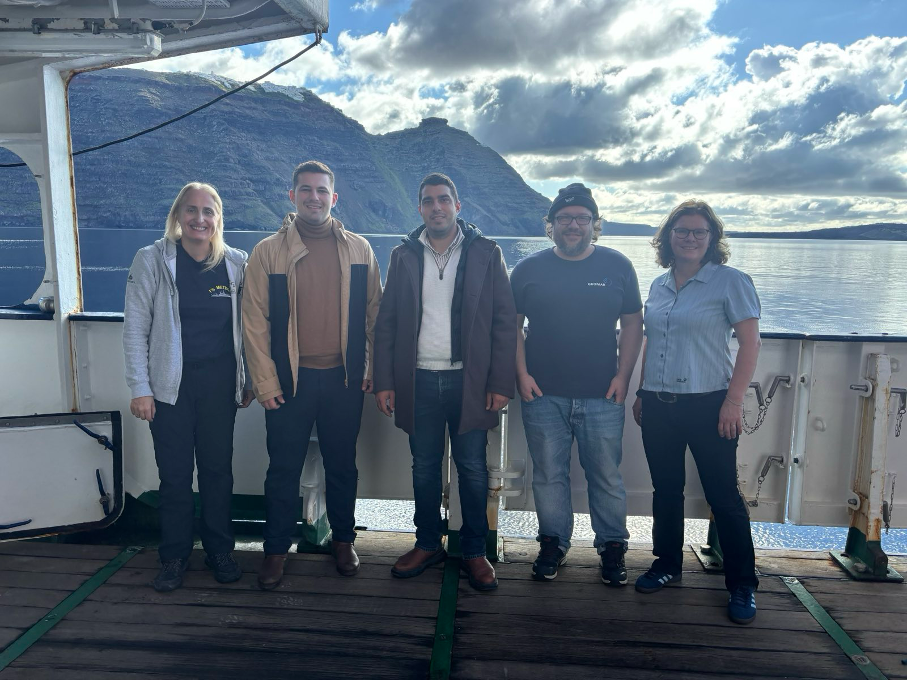
This is entirely in line with the project MULTI-MAREX, as two living labs are being set up in Greece as part of this project, one in Kalamata and one here in Santorini. A living lab is a geographically defined space for collaboration between researchers and stakeholders. Research questions are defined jointly and solutions are tested. It is therefore a special type of research in which local people are directly involved and their knowledge of the environment and local characteristics is incorporated into the research projects. The results of the research will in turn have direct benefits for stakeholders and residents. That is why MULTI-MAREX, and this third cruise on behalf of the project, is also very much about making our findings applicable.
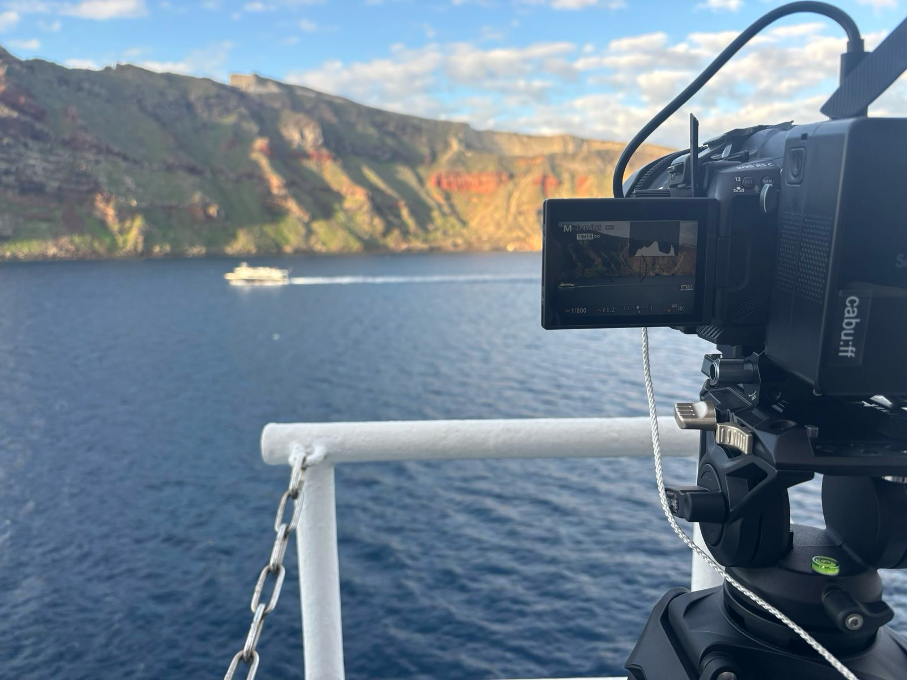
One task on board that serves this purpose is to visualise the steep coastline of Santorini in a three-dimensional model using photogrammetry. The first step involves taking as many overlapping photos as possible of selected coastal sections. To do this, we sail close to the coast at reduced speed through the caldera while continuously taking photos. By overlapping the images, the third dimension, depth, can be calculated for model creation, resulting in a coherent model of the coastline. This will be made freely available to stakeholders and citizens and will be used for educational purposes, among other things. However, such a model can also be used to identify potential slope instabilities at an early stage.
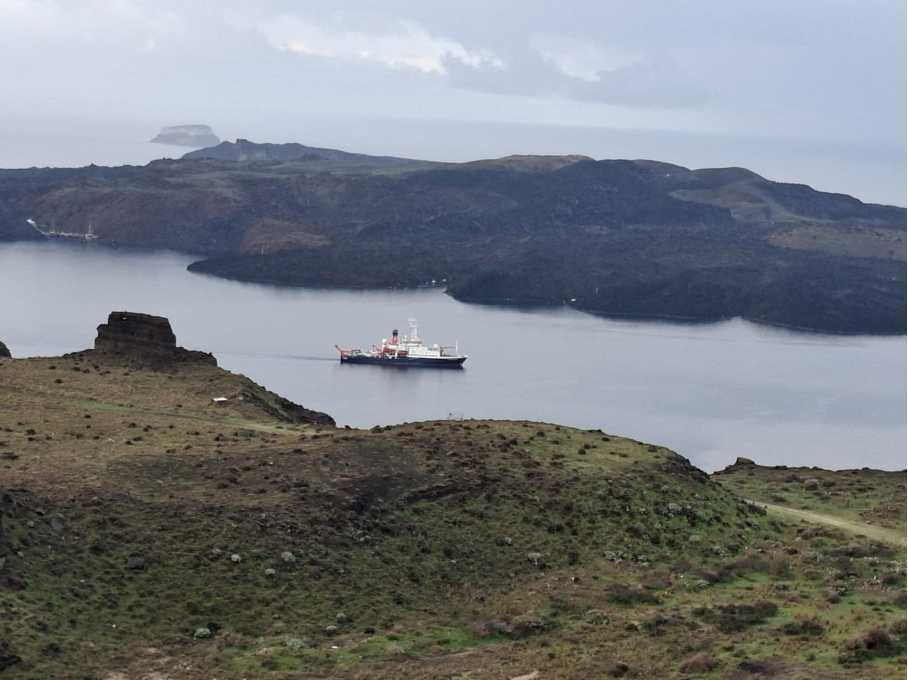
Some of the team are already familiar with Santorini. As part of MULTI-MAREX, some of us have been here several times in recent years, both on board and ashore, and have had the privilege of getting to know some of the stakeholders, students and residents. This makes it all the more enjoyable to see the island and its people again, even though we spend most of the trip looking at the islands’ coastline from a distance from the RV METEOR. Our presence in and around the Santorini caldera does not go unnoticed by the island’s residents, of course. We are always delighted to receive photos of the RV METEOR taken from Santorini. So while we admire the islands of Santorini from the ship, people there are looking back at us. We send our best regards to everyone who has spotted our research vessel over the last few days!
We wish all our readers a happy New Year’s Eve and look forward to another year of science and collaboration. We will be back in touch from aboard the RV METEOR!
The M215 (MMC-3) team